Vikas
Vikas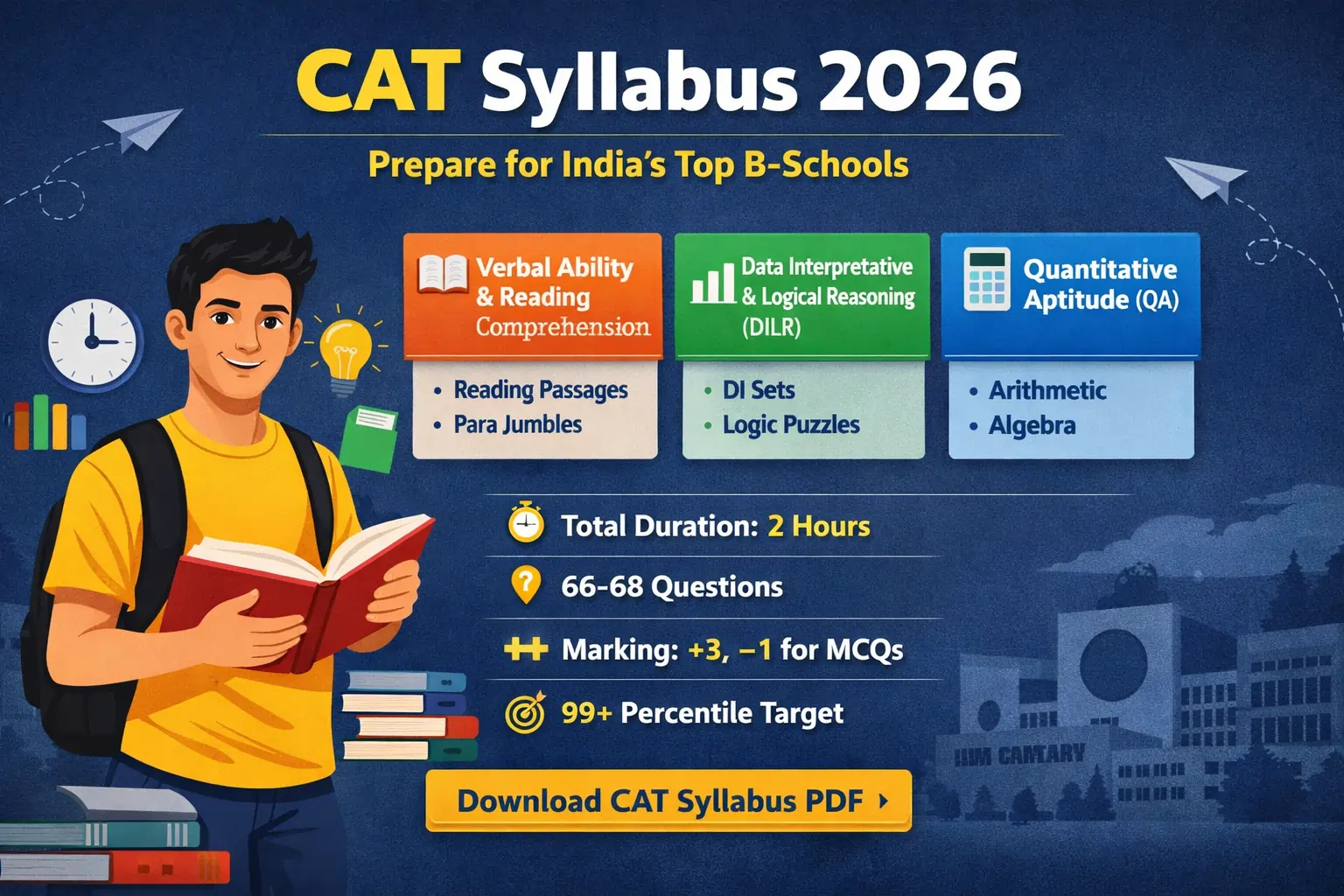
The CAT Syllabus 2026 includes three major sections: Verbal Ability & Reading Comprehension (VARC), Data Interpretation & Logical Reasoning (DILR), and Quantitative Aptitude (QA). The Common Admission Test (CAT) is India’s most competitive MBA entrance exam conducted annually by the Indian Institutes of Management (IIMs).
If you are preparing for CAT 2026, understanding the latest CAT exam pattern, section-wise syllabus, topic weightage, difficulty trends, and preparation strategy is essential to score 99+ percentile.
This detailed guide covers everything you need to know about the latest CAT syllabus 2026.
CAT 2026 at a Glance (Quick Summary for Aspirants)
- Exam Name: Common Admission Test (CAT)
- Conducting Body: Indian Institutes of Management (IIMs)
- Exam Mode: Computer Based Test (CBT)
- Total Duration: 120 Minutes (40 minutes per section)
- Total Sections: 3 (VARC, DILR, QA)
- Question Types: MCQ + TITA (Type In The Answer)
- Marking Scheme: +3 for correct, -1 for incorrect MCQ, no negative for TITA
- Difficulty Level: Moderate to Difficult
- Most Important Topics: Arithmetic, Reading Comprehension, DI Caselets, Algebra
What is CAT Syllabus 2026?
The CAT syllabus 2026 is not officially predefined by IIMs. However, based on previous year trends, the exam tests candidates on graduation-level aptitude in three areas: language comprehension, analytical reasoning, and mathematics.
Unlike other exams, CAT focuses heavily on conceptual clarity, logical reasoning, and time management rather than rote learning.
The syllabus remains largely consistent every year, but the difficulty level and question distribution may vary.
CAT Exam Pattern 2026 (Latest Structure)
Understanding the CAT exam pattern 2026 is as important as knowing the syllabus.
Key Highlights
- Total Duration: 2 Hours
- Sectional Time Limit: 40 Minutes per section
- No Section Switching Allowed
- Approximately 66–68 Questions
- Both MCQ and TITA format
Section Wise Expected Question Distribution
| Section | Expected Questions | Time Limit |
|---|---|---|
| VARC | 24 | 40 Minutes |
| DILR | 20–22 | 40 Minutes |
| QA | 22 | 40 Minutes |
Marking Scheme
- +3 for correct answer
- -1 for incorrect MCQ
- No negative marking for TITA
Has CAT Pattern Changed Recently?
In recent years, CAT reduced duration from 3 hours to 2 hours and slightly reduced question count. The sectional structure remains unchanged.
CAT Syllabus 2026 – Section Wise Detailed Breakdown
1. VARC Syllabus 2026 (Verbal Ability & Reading Comprehension)
The VARC section carries the highest weightage and primarily focuses on reading comprehension.
Reading Comprehension (Major Portion)
Expected RC Passages: 4
Questions per RC: 4–5
RC Topics Frequently Asked
- Business & Economics
- Philosophy
- Psychology
- Sociology
- Science & Technology
- Abstract Themes
RC contributes nearly 70% of the VARC section.
Verbal Ability Topics
- Para Jumbles
- Para Summary
- Odd Sentence Out
- Sentence Rearrangement
- Sentence Completion
- Vocabulary (Synonyms & Antonyms)
- Grammar Basics
VARC Difficulty Trend
RC passages have become inference-based rather than fact-based. Questions test comprehension depth rather than vocabulary strength.
VARC Strategy
- Prioritize RC selection
- Avoid over-attempting VA if confused
- Focus on accuracy over attempts
- Practice diverse reading sources
2. DILR Syllabus 2026 (Data Interpretation & Logical Reasoning)
The DILR section is unpredictable and requires smart set selection.
Data Interpretation Topics
- Tables
- Line Graphs
- Bar Charts
- Pie Charts
- Caselets
- Mixed Graphs
- Data Sufficiency
Logical Reasoning Topics
- Seating Arrangement
- Blood Relations
- Syllogisms
- Venn Diagrams
- Puzzles & Games
- Direction Sense
- Logical Deduction
DILR Strategy
- Attempt easiest set first
- Do not attempt all sets
- Spend first 5 minutes scanning sets
- Practice mixed sets regularly
DILR success depends more on set selection than solving speed.
3. Quantitative Aptitude Syllabus 2026
QA focuses heavily on Arithmetic and Algebra.
Arithmetic (Highest Weightage – 35–45%)
- Percentages
- Profit & Loss
- Ratio & Proportion
- Averages
- Time & Work
- Time, Speed & Distance
- Mixtures & Alligation
Algebra
- Linear Equations
- Quadratic Equations
- Inequalities
- Logarithms
- Functions
Geometry & Mensuration
- Triangles
- Circles
- Coordinate Geometry
- Polygons
Number System
- Divisibility
- LCM & HCF
- Surds & Indices
Modern Math
- Permutation & Combination
- Probability
- Set Theory
CAT 2026 Topic Weightage Analysis
| Section | High Weightage Topics | Approx Weightage |
|---|---|---|
| VARC | Reading Comprehension | 65–70% |
| DILR | DI Caselets + Puzzles | 100% set-based |
| QA | Arithmetic | 40% |
| QA | Algebra | 25% |
Understanding weightage helps prioritize preparation.
High Scoring Topics in CAT 2026
If targeting 99+ percentile:
- Arithmetic
- Reading Comprehension
- Algebra
- DI Caselets
- Seating Arrangement Puzzles
Mastering these increases scoring efficiency.
How to Prepare for CAT Syllabus 2026 – Complete Strategy & Study Plan
Preparing for the CAT exam is not just about covering the syllabus. It is about mastering concepts, improving speed, maintaining accuracy, and developing smart decision-making skills under time pressure.
Since the CAT syllabus does not change drastically every year, what truly differentiates top scorers is their preparation strategy and mock analysis approach.
Below is a structured preparation roadmap designed for both beginners and serious aspirants targeting 99+ percentile.
Step 1: Understand the CAT Exam Structure Before Starting
Before beginning preparation, clearly understand:
- Sectional time limit (40 minutes per section)
- No switching between sections
- Presence of TITA questions (no negative marking)
- Importance of set selection in DILR
- Weightage of Arithmetic in QA
- Dominance of RC in VARC
Many aspirants fail not because of weak concepts, but because they ignore exam structure.
Step 2: Strengthen Fundamentals (First 2–3 Months)
Your primary goal should be concept clarity, not speed.
Quantitative Aptitude
Start with Arithmetic as it carries the highest weightage.
Focus on:
- Percentages
- Ratio & Proportion
- Profit & Loss
- Time & Work
- Averages
Build a formula notebook and revise weekly.
VARC
- Read long-form articles daily (editorials, business, philosophy topics)
- Practice 1 RC passage daily
- Work on Para Jumbles and Summary questions
- Improve comprehension rather than memorizing vocabulary
DILR
- Begin with basic puzzle sets
- Learn to structure information in tables
- Practice 3–4 sets weekly initially
At this stage, avoid taking too many full mocks.
Step 3: Move to Sectional Tests & Timed Practice
Once basics are clear, start timed sectional tests.
- Attempt 1 sectional test per section weekly
- Practice 40-minute format strictly
- Track accuracy percentage
- Analyze mistakes deeply
The goal is to increase both speed and consistency.
Step 4: Start Full-Length Mock Tests
Mock tests are the backbone of CAT preparation.
How Many Mocks?
- 1 mock per week initially
- Increase to 2–3 mocks per week in final 2 months
Mock Analysis Framework
After every mock:
- Identify conceptual mistakes
- Identify calculation errors
- Analyze time mismanagement
- Re-solve unsolved questions
Spending 2–3 hours analyzing one mock is more valuable than attempting multiple mocks without review.
Section-Wise Preparation Strategy
VARC Strategy
- Prioritize RC passages you are comfortable with
- Avoid spending too much time on one question
- Aim for 80–85% accuracy
- Practice inference-based questions
DILR Strategy
- Spend first 5 minutes scanning all sets
- Attempt only 2–3 strong sets
- Avoid ego-based attempts
- Focus on structured solving
QA Strategy
- Attempt arithmetic first
- Skip lengthy geometry if time-consuming
- Maintain high accuracy (85%+)
- Avoid blind guessing
Preparation Strategy for Working Professionals
If you are preparing with a full-time job:
- Study 2 hours daily on weekdays
- 4–5 hours on weekends
- Take 1 mock every weekend
- Use commute time for reading practice
Consistency matters more than long study sessions.
How Many Hours Should You Study for CAT?
- Beginners: 3–4 hours daily
- Working professionals: 2 hours daily + weekends
- Final 2 months: 4–5 hours including mock analysis
Focus on quality practice instead of just increasing study hours.
Common Mistakes to Avoid in CAT 2026
- Attempting all DILR sets
- Ignoring arithmetic fundamentals
- Skipping mock analysis
- Guessing excessively in MCQs
- Not managing sectional time properly
CAT Score vs Percentile Insight (Expected Trend)
| Score Range | Expected Percentile |
|---|---|
| 95–105 | 99+ |
| 80–90 | 97–98 |
| 65–75 | 90–95 |
| 50–60 | 80–85 |
(Exact percentiles vary yearly based on difficulty.)
Frequently Asked Questions (FAQs) – CAT Syllabus 2026
Is CAT syllabus 2026 officially released by IIMs?
No, the Indian Institutes of Management (IIMs) do not release an officially fixed or detailed syllabus for CAT. However, based on consistent trends over the past years, the CAT exam syllabus includes three sections: Verbal Ability & Reading Comprehension (VARC), Data Interpretation & Logical Reasoning (DILR), and Quantitative Aptitude (QA). The exam tests graduation-level aptitude, logical reasoning, analytical skills, and mathematical fundamentals. While the structure remains stable, difficulty level and question distribution may vary each year.
Has the CAT syllabus changed in recent years?
The core CAT syllabus has remained largely unchanged. The exam still consists of three sections — VARC, DILR, and QA. However, minor changes have occurred in exam duration and question count. For example, the duration was reduced from 3 hours to 2 hours in recent years. The emphasis on inference-based Reading Comprehension and arithmetic-heavy Quantitative Aptitude has increased. So while the syllabus remains the same, preparation strategy must evolve based on trends.
What are the most important topics in CAT 2026?
High-weightage topics in CAT 2026 are expected to be:
- Reading Comprehension (VARC)
- Arithmetic (QA)
- Algebra (QA)
- DI Caselets (DILR)
- Seating Arrangement & Puzzle Sets (DILR)
Arithmetic alone contributes nearly 35–45% of the Quant section, while RC dominates the VARC section. Focusing on these high-scoring areas can significantly improve your overall percentile.
What is the difficulty level of CAT exam?
The CAT exam is generally considered moderate to difficult. VARC passages are inference-based, DILR sets are logic-intensive and unpredictable, and Quant requires strong conceptual clarity. The level is comparable to graduation-level aptitude but requires high speed and accuracy under time pressure. Achieving a 99+ percentile demands both conceptual mastery and strategic mock practice.
How many questions are there in CAT 2026?
CAT is expected to have approximately 66–68 questions, divided across three sections. VARC usually contains around 24 questions, DILR around 20–22 questions, and QA around 22 questions. However, the exact distribution may slightly vary depending on the conducting IIM.
Is there negative marking in CAT?
Yes, CAT follows a negative marking system for multiple-choice questions (MCQs). Candidates receive +3 marks for every correct answer and -1 mark for every incorrect MCQ. However, there is no negative marking for TITA (Type In The Answer) questions. This means strategic attempt planning is crucial to avoid unnecessary score reduction.
Can I crack CAT in 6 months?
Yes, it is possible to crack CAT in 6 months with focused preparation and disciplined mock practice. The key is prioritizing high-weightage topics like Arithmetic, Reading Comprehension, and Logical Reasoning sets. A structured study plan, regular sectional tests, and deep mock analysis are essential. Consistency matters more than long study hours.
Which section is toughest in CAT?
DILR is often considered the toughest section because of its unpredictable and set-based nature. Unlike Quant or VARC, where individual questions can be solved independently, DILR requires solving complete sets. Choosing the right sets within the first few minutes plays a crucial role in performance.
What is the sectional time limit in CAT?
CAT has a sectional time limit of 40 minutes per section. Candidates cannot switch between sections during the exam. Once the 40-minute window ends, the system automatically moves to the next section. This makes time management and sectional strategy extremely important.
How should beginners start preparing for CAT syllabus?
Beginners should start by strengthening basics in Arithmetic and improving reading habits for VARC. Instead of jumping directly into mock tests, focus first on conceptual clarity. Once basics are covered, start sectional tests and gradually move to full-length mocks. Consistent revision and error analysis are key to improvement.
Does CAT syllabus include advanced mathematics?
No, CAT does not include advanced or engineering-level mathematics. The Quantitative Aptitude section mainly covers arithmetic, algebra, geometry, number system, and modern math topics taught up to Class 10–12 level. However, questions are application-based and require logical interpretation rather than formula memorization.
How many Reading Comprehension passages are asked in CAT?
Typically, CAT includes 4 Reading Comprehension passages with 4–5 questions each. RC contributes nearly 70% of the VARC section. Passages are usually drawn from areas like philosophy, economics, psychology, science, and abstract themes.
Is CAT tougher than other MBA entrance exams?
CAT is generally considered tougher than many other MBA entrance exams because of its high competition level and percentile-based evaluation. The difficulty level of questions combined with intense competition makes it challenging. However, with smart preparation and mock analysis, cracking CAT is achievable.